La comunidad investiga su propia realidad.
At CCATE, community members are researchers — not subjects. Parents, teenagers and staff design the questions, collect the data, analyze it together and decide what to do with what they find.
Why community-led research
A community’s knowledge is missing from the research about it.Por qué investigamos nosotros mismos
Norristown’s Latinx residents have deep expertise on the challenges they live with — and are routinely studied rather than centered as the people who produce knowledge. When community members are treated as data points, the resulting research is incomplete, culturally misaligned, and less likely to change anything.
Sources: Norristown Area School District data, 2024–25; U.S. Census Bureau, Montgomery County.
Un ecosistema de investigaciónNot a program — three circles that work together
Over more than a decade CCATE has built a multi-generational research infrastructure: adults, young people and university partners, each with their own circle, meeting on their own schedule, working on questions the community itself raised.
Participatory Research Circle
CCATE’s cornerstone adult research circle. Community members trained as researchers set the questions, choose the methods and decide how findings are shared. More than 200 weekly sessions to date.
Youth Participatory Action Research
Middle and high school students trained as researchers. Past projects: school district funding, postsecondary planning, bilingualism and biliteracy, and CCATE’s own waste and recycling systems.
Health Circle
Founded by members of the Research Circle to promote, humanize and dignify health and health care for the Latinx community — beginning with a community-run health census.
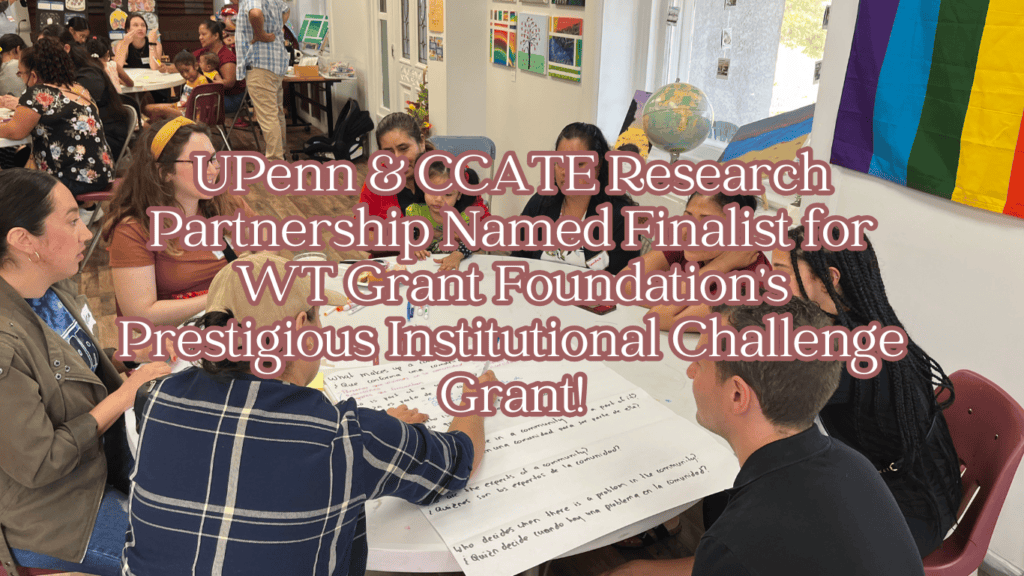
CCATE & the University of PennsylvaniaTwenty-five researchers, one shared agenda
An intergenerational partnership with Penn’s Graduate School of Education, School of Social Policy and Practice, and Center for Latin American and Latinx Studies. Twenty-five people — CCATE parents, students, staff, board members, and Penn faculty and doctoral students — meet monthly and set the agenda together.
The community named the focus: postsecondary success, and within it, how parents and students talk to each other about what comes after high school, mental health, and school and community violence.
- 2022–23Pilot focus groups and interviews on the three topics.
- 2024–2610 parent focus groups and 6 youth focus groups with more than 25 CCATE families.
- 2026Methodological innovations from the analysis accepted for the annual conference of the American Educational Research Association; articles for academic and community publications in progress.
Qué hemos investigadoTen years of research strands
With Penn faculty: what actually happens between immigrant families and their schools. A research panel at Penn GSE, a co-authored publication, and an invited panel for educators at Rutgers.
A case study of families where one or more members is undocumented. Findings on long-term childhood trauma from immigration enforcement — and its effect on school performance.
Pandemic focus groups with CCATE families and Latinx business owners, written up as policy memos for Congresswoman Madeleine Dean.
A community health census, resource guides, connections to local providers, weekly food baskets during the pandemic, and several Health Weeks a year.
A photovoice project on unearthing cultural roots, shared as a two-part podcast series; eight Spanish-language immigration narratives to be published in REVARTE; a storytelling collaboration with Haverford College students in 2026.
Findings brought as public comment to Norristown Area School District board meetings, and founding membership in Norristown Area CARES, a community advisory group that meets with district administrators.
The Veritas ProjectLead exposure in Norristown’s Latinx neighborhoods
Norristown’s industrial past left lead in its soil, water and paint — concentrated in the neighborhoods where Latinx families live, a pattern set by decades of residential segregation. The Veritas Project asks a question no outside researcher could have asked alone: what are the community’s own priorities for assessing and addressing that risk?
Co-led by community leaders from CCATE’s Environmental Justice Research Circle with faculty from Villanova’s Department of Geography and the Environment and College of Nursing — including two CCATE board members.
- Phase 1Four Spanish-language focus groups with 73 participants, coded and analyzed: sources of contamination, missing information, institutional negligence, and financial consequences.
- Phase 2Water and soil testing with results returned to the community at public listening sessions; paint test kits distributed; blood lead serosurveys under way.
- NextA bilingual website on lead exposure, publication of findings, and outreach to policy representatives.
Lo que ha cambiadoWhat community-led research has actually changed
The premise is simple: when a community produces the knowledge about its own life, that knowledge is more accurate, more trusted and more likely to change something. Some of what has followed:
- Research Circle advocacy led to the creation of Norristown Area CARES, a standing community advisory body that meets with district administrators.
- Circle members were hired as consultants to train Norristown Area School District community liaisons and interpreters in cultural sensitivity.
- The district began offering Spanish as an elective starting in middle school.
- The Veritas Project produced community-validated environmental health priorities — the result of trust-based, Spanish-language, culturally grounded engagement.
- CCATE alumni return as research interns, mentors and community connectors.
ReconocimientosRecognition
PublicacionesPeer-reviewed work, co-authored with community researchers
Community members appear as authors, not informants.
- Zavala-Garcia et al. (2025). Discover Social Science and Health, vol. 6, art. 12.
- Arango, O., Link, H., Castillo, M. G., De la Luz-López, H., Flores, L., Sánchez, L. & Lugo-Martínez, D. (2021). “RevArte: Educación dialógica es educación para amar y transformar.” Atenas, 2(54), 18–38.
- Arango, O., Castillo, G., De La Luz, H., Flores, L., Link, H., Lugo, D. & Sánchez, L. (2021). “All of the Knowledge [of the World] from and for Everyone: Exploring New Epistemologies through Participatory Research for Equity and Inclusion.” Gemeinsam leben, 1/2021.
- Arango, O., Flores, S., Gallo, S., Lara, P., Link, H., Lugo, D. & Peregrina, I. (2016). “Un trago dulce pero adentro con sabor amargo: Constructing counterspaces to explore undocumented status across academic, family and community spaces.” Diaspora, Indigenous, and Minority Education.
Selected invited presentations: Ethnography in Education Research Forum at Penn GSE (annually 2015–2020, featured speakers in 2020); Rutgers University; University of Guanajuato (plenary, 2017 and 2019); American Anthropological Association; American Association for Applied Linguistics; West Chester, Temple, Cabrini and UT–El Paso.
Health CircleCommunity researchers working on health
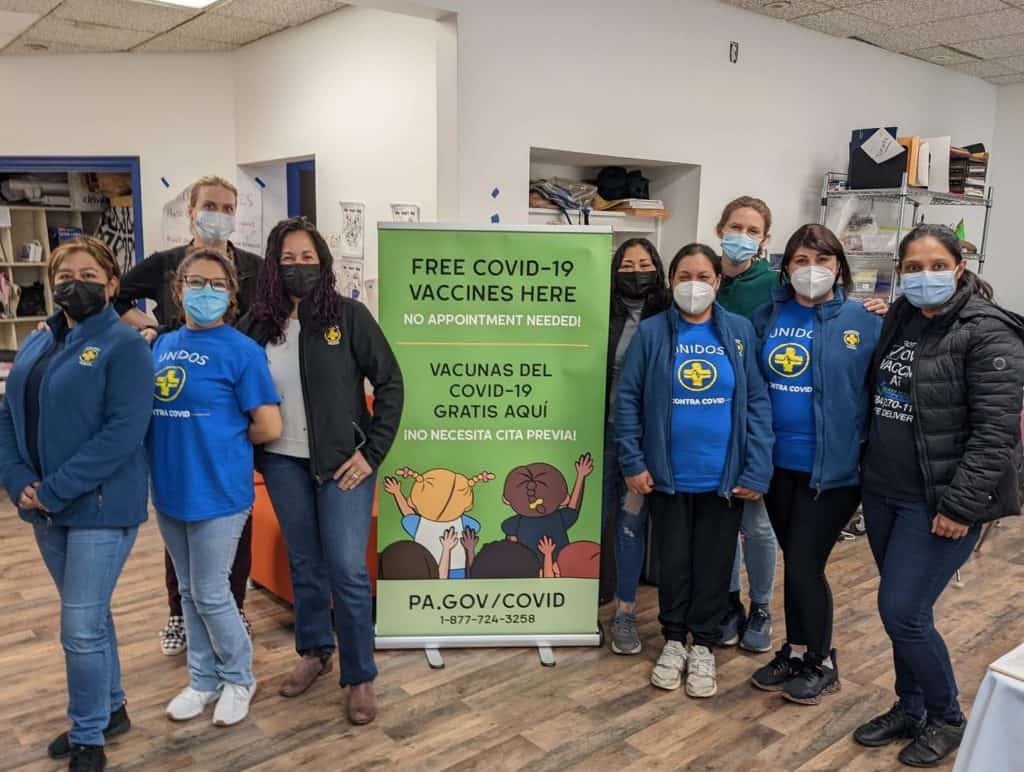
Founded by Research Circle members with support from Curaméricas Global, the Health Circle began by running its own health census of the community’s needs. What it found shaped everything since: resource guides in Spanish, connections to local providers and pharmacies, weekly food baskets during the pandemic, and several Health Weeks a year with workshops on grief, adverse childhood experiences, food systems, heart health and fitness, plus vaccination clinics.
Partners include East Norriton Pharmacy and the nursing schools of Villanova University and the University of Pennsylvania. In 2026 the circle trained in Adult Mental Health First Aid in Spanish.
Derechos y poder cívicoRights, assemblies and community resources
Research is one way the community speaks for itself. Assemblies are another. In January 2025, 400 people filled our building for an immigration assembly with the Mexican Consul, members of Congress and immigration attorneys. A business owners’ assembly represented 480 jobs across seven municipalities. In March 2025, a mental health assembly brought together community members, university faculty, county representatives and the Consulate — and set an agenda the Research Circle is now taking up.
¿Quieres investigar con nosotros?Join a circle — or partner with one
The Research Circle meets weekly and welcomes new community members. University partners interested in community-led research can write to us directly.
¡Viva la comunidad!