Todo el conocimiento del mundo, desde todos y para todos.

All the knowledge of the world, from everyone and for everyone.

CCATE’s Center for Participatory Research is a community of researchers that grew out of Norristown’s Latinx immigrant community. Parents, young people and staff ask the questions, gather the evidence, analyze it together and decide what happens with what they find.

El Círculo de InvestigaciónHow the Research Circle began

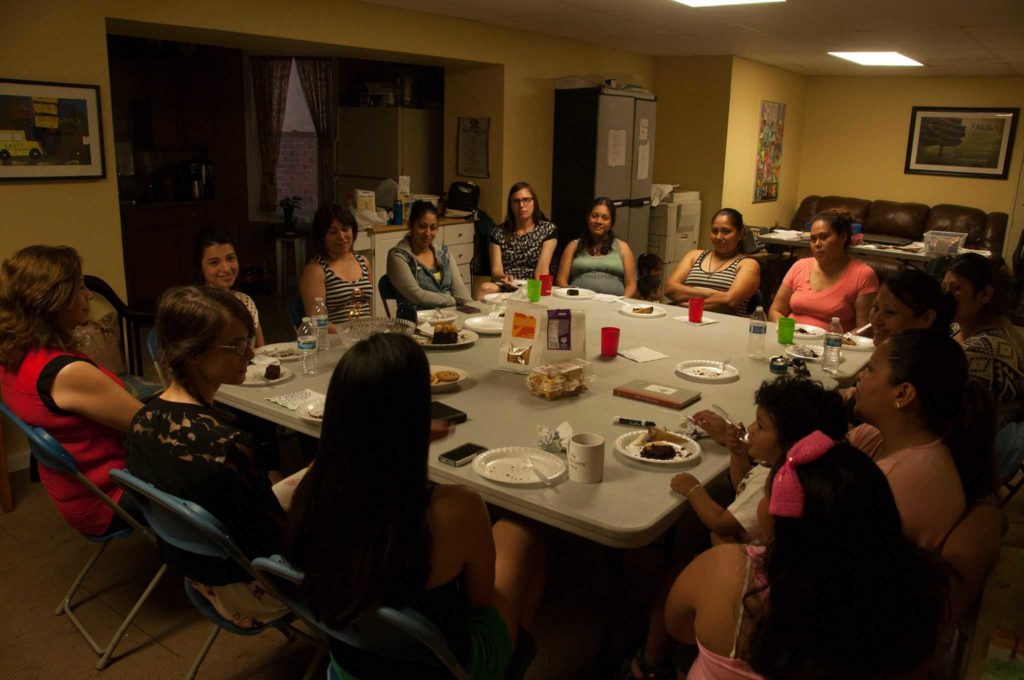
Our research circle first came together in 2015 to present at the Ethnography in Education Research Forum at the University of Pennsylvania’s Graduate School of Education, where CCATE families and teachers shared family perspectives on home–school communication for Latinx immigrants. From that experience the circle co-wrote its first article, on documentation status and schooling, published in 2016 in the Journal of Diaspora, Indigenous, and Minority Education. The Circle formally established itself in 2018 and has since carried out research on the challenges the community faces and developed policy recommendations from what it learned.

We conduct dignifying and humanizing community-based research. Together we work toward a future in which our research shapes public policy, opens full access to education for and from the community, and creates counter-narratives that challenge the systems that dehumanize our families and other minoritized groups. We do this collectively, with a critical lens, and with the commitment to work tirelessly from, with and for the community.

Somos una comunidad de investigadores que ha surgido de la comunidad de inmigrantes latinos y que estamos realizando investigaciones comunitarias dignificantes y humanizadoras. Juntos trabajamos hacia un futuro mejor en el que nuestra investigación afectará las políticas públicas, facilitará el acceso total a la educación para y desde la comunidad y creará contra narrativas que desafíen los sistemas dominantes que deshumanizan a nuestras familias y otros grupos minoritarios. Para alcanzar estos objetivos, trabajamos en colectividad con lente crítico y compromiso de hacerlo incansablemente desde, con y para la comunidad.

  • 2015First presentation by CCATE families and teachers at Penn’s Ethnography Forum.
  • 2016First co-authored article, on documentation status and schooling.
  • 2018The Research Circle is formally established; its members found the Health Circle.
  • 2019Youth Participatory Action Research begins with middle and high school students.
  • 2022Research-practice partnership with the University of Pennsylvania begins.
  • 2025–26Penn Provost / Netter Center award, peer-reviewed publications, and new projects with Haverford College and Villanova University.
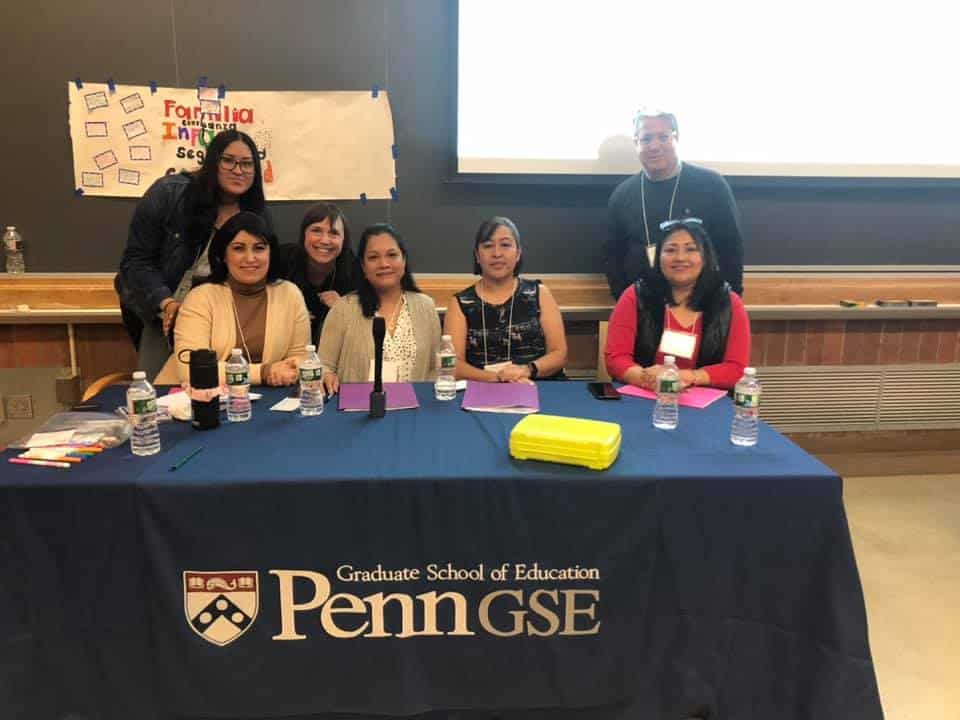
Early meeting of the CCATE Research Circle around a table CCATE Research Circle presenting as featured speakers at the 2020 Ethnography in Education Research Forum

Cómo investigamosWhat makes research participatory here

The community sets the questions

Topics come from families’ own concerns — schools, health, immigration, the neighborhood — not from an outside research agenda.

Researchers, not subjects

Parents and students are trained in research ethics and methods, analyze the data themselves, and appear as co-authors on what is published.

Spanish first

Focus groups, surveys and dialogues take place in the language people think and feel in, with bilingual versions for allies and institutions.

Findings go back home

Results return to the community before anyone else: at listening sessions and assemblies, on our podcast, and in REVARTE.

Protecting people

We share stories through composite cases and collective authorship so no family can be identified, and we keep faces out of public images.

Methods we use: focus groups and interviews, photovoice, testimonios and composite counter-stories, community surveys, dialogue groups at public assemblies, audio documentary, and environmental sampling with scientific partners.

Investigación en cursoCurrent research, 2025–2026

Today the Center brings together an adult research circle, a youth research team and several university partnerships — each with its own questions and rhythm.

Navegando Juntes

With the University of Pennsylvania

An intergenerational research-practice partnership between CCATE families, students, staff and Penn faculty and doctoral students. After a first year of monthly dialogues and a second year of research training and certification, the team began its own study of postsecondary success: how parents and young people talk about life after high school, and how mental health and school and community violence shape those plans.

8adult focus groups and an interview, with 17 parents
4youth focus groups with 10 young people
25families: the study’s full sample goal

In summer 2026 the team met to build composite cases — stories that weave several families’ experiences together so the findings are true to the community while protecting everyone’s identity. The methodological innovations behind this approach were presented at the American Educational Research Association Annual Meeting in April 2026.

Now: sharing findings with families and schools, and preparing articles for academic and community audiences.

Relatos en comunidad

Photovoice, storytelling and audio documentary

The adult Research Circle documents immigrant memory in the community’s own words and images. A photovoice project on cultural roots became a two-part podcast series. In spring 2026 a storytelling collaboration with Haverford College students, through the Together with the Humanities program, culminated in a public presentation at Haverford on May 4, 2026.

The Circle has approved the design of La Villa Inmigrante, a 15-episode audio documentary to preserve immigrant memory and challenge the criminalization of migrants, and is preparing a collection of Spanish-language immigration narratives for publication in REVARTE.

Now: publishing the photovoice stories and producing the first documentary episodes.

Youth Participatory Action Research

High school and middle school researchers

Students investigate the issues that matter to them and their families, with support from university partners. Past projects have examined school district funding, bilingualism and biliteracy, postsecondary planning, and CCATE’s own waste and recycling systems.

7student researchers in 2025–26: six in high school, one in middle school
2023–24first full round of data collection, analyzed by the youth themselves

In 2025 the youth team presented at Penn’s Ethnography in Education Research Forum and shared its postsecondary research with an undergraduate class of about 100 students at Penn. In spring 2026 the team extended the postsecondary research with Norristown Area High School students.

Now: an article on the postsecondary research is in the final stage of submission.

Youth Assembly

Organized by young people from several school districts

Young people were largely missing from the community’s 2026 immigration assembly — parents did most of the talking. So a youth committee from several school districts is organizing an assembly of its own for ages 13 to 25. It is participatory action research from the start: the youth set the agenda, chose the survey instrument, and will write the report, with health professionals, attorneys, universities, school leaders and elected officials invited to listen.

Participants under 18 need a parent or guardian’s authorization. Contact us to take part.

Community Assembly on Migration

Report co-published with the HealthSpark Foundation

An assembly designed as research: before arriving, community members and allies answered the same survey — in Spanish and in English — revealing where their perspectives differ. On the day, participants met in small dialogue groups that each mixed community members with mental health and legal professionals, and representatives from the school district up to Congress listened in.

107participants, about half of them immigrant community members
20dialogue groups

The central finding: the community’s first need is emotional health. The resulting report is written to help foundations, nonprofits and local government respond to what families actually need.

The Veritas Project

Environmental justice, with Villanova University

CCATE’s Environmental Justice Research Circle and Villanova faculty in geography, the environment and nursing are studying lead in the soil, water and paint of Norristown’s Latinx neighborhoods — starting from the community’s own priorities for assessing and addressing that risk.

73residential tests of water, soil and paint in summer 2025
100trees planted in Norristown since fall 2022, with 15 community Tree Tenders

Results are returned to households and at community sessions. A paper, “Total and Bioaccessible Soil Lead Contamination in Predominantly Hispanic Neighborhoods around Norristown, PA,” was submitted to Environmental Geochemistry and Health in April 2026, and a three-year air quality study with Villanova and Temple University is under way.

Related: the Health Circle, founded by members of the Research Circle in 2018.

ReconocimientosRecognition

Penn Provost / Netter Center AwardFaculty-Community Partnership Award, December 2025, for the CCATE–Penn research partnership.
Carnegie Classification, 2026Penn cited its collaboration with CCATE in earning the Community Engagement Classification.
William T. Grant FoundationThe Penn–CCATE partnership was one of seven national finalists for the Institutional Challenge Grant, 2025.
Penn Interdisciplinary Research Cluster GrantsSupport for the research-practice partnership in 2023 and 2024.

PublicacionesCommunity researchers as authors

  • Under review“Total and Bioaccessible Soil Lead Contamination in Predominantly Hispanic Neighborhoods around Norristown, PA.” Submitted to Environmental Geochemistry and Health, 2026.
  • Zavala-Garcia et al. (2025). Discover Social Science and Health, vol. 6, art. 12.
  • Arango, O., Link, H., Castillo, M. G., De la Luz-López, H., Flores, L., Sánchez, L. & Lugo-Martínez, D. (2021). “RevArte: Educación dialógica es educación para amar y transformar.” Atenas, 2(54), 18–38.
  • Arango, O., Castillo, G., De La Luz, H., Flores, L., Link, H., Lugo, D. & Sánchez, L. (2021). “All of the Knowledge [of the World] from and for Everyone: Exploring New Epistemologies through Participatory Research for Equity and Inclusion.” Gemeinsam leben, 1/2021.
  • Arango, O., Flores, S., Gallo, S., Lara, P., Link, H., Lugo, D. & Peregrina, I. (2016). “Un trago dulce pero adentro con sabor amargo: Constructing counterspaces to explore undocumented status across academic, family and community spaces.” Journal of Diaspora, Indigenous, and Minority Education.

PresentacionesPresentations, 2015–2026

Community researchers present their own work at universities and conferences in the United States and Mexico.

20262 presentations
  • Methodological innovations from the Navegando Juntes research-practice partnership, presented at the American Educational Research Association Annual Meeting, April 2026.
  • Final presentation and celebration of the CCATE–Haverford College storytelling collaboration (Together with the Humanities), Haverford College, May 4, 2026.
20252 presentations
  • Youth Participatory Action Research team presentation at the Ethnography in Education Research Forum, Graduate School of Education, University of Pennsylvania, Philadelphia, PA, February 2025.
  • CCATE high school researchers present their postsecondary research to an undergraduate class at the University of Pennsylvania, spring 2025.
20201 presentation
  • “All the Knowledge of the World for and from Everyone,” CCATE Community-based Participatory Research Circle invited as Featured Speakers at the Ethnography in Education Research Forum, Graduate School of Education, University of Pennsylvania, Philadelphia, PA, February 2020.
20192 presentations
  • “The Exploration of New Epistemologies through Participatory Research,” Obed Arango and Holly Link invited as Plenary Speakers, representing CCATE’s Community-based Participatory Research Circle at the Fourth International Colloquium, “Derecho al bienestar humano, ética global y educación,” University of Guanajuato, Mexico, November 2019.
  • “La vida” y “Sueños” [“Life” and “Dreams”]: Dialogic Arts Pedagogy for New Epistemologies. Presentation by CCATE teachers and high school students at the Ethnography in Education Research Forum, Graduate School of Education, University of Pennsylvania, Philadelphia, PA, February 2019.
20183 presentations
  • “Walls Down, Knowledge for All: Community Circles for Empowerment.” Presentation by CCATE Community-based Participatory Research Circle at the Tenth Annual Latino Communities Conference, West Chester University, West Chester, PA, September 2018.
  • “La vida tiene muchas curvas: Contemplating a Translanguaging Praxis.” Presentation by Obed Arango and Holly Link on language pedagogy at CCATE, Annual Conference of the American Association for Applied Linguistics, Chicago, IL, March 2018.
  • “Using Your Voice to Affect Change in Your Community.” Presentation by CCATE high school group, Students Today, Leaders Tomorrow, at Norristown Area High School Diversity Day Conference, Norristown, PA, April 2018.
20175 presentations
  • “Counterstories from the villa inmigrante,” a participatory research project by CCATE adult reading circle. Paper presentation at the Annual Meeting of the American Anthropological Association, Washington, DC, November 2017.
  • “Bilingual Community Education in the villa inmigrante,” by Dr. Holly Link. Invited plenary talk on CCATE at the Third International Colloquium, “Derecho al bienestar humano, ética global y educación,” University of Guanajuato, Mexico, November 2017.
  • “Revolución Arte: Social Transformation in the Villa Inmigrante.” Presentation by high school leadership team at the Ninth Annual Latino Communities Conference, West Chester University, West Chester, PA, September 2017.
  • “Revolución Arte: Social Transformation in the Villa Inmigrante.” Panel presentation by high school leadership team, film class and adult reading circle at the Ethnography in Education Research Forum, University of Pennsylvania Graduate School of Education, Philadelphia, PA, February 2017.
  • “Villa inmigrante,” by Obed Arango. Invited presentation on CCATE at the Annual Martin Luther King, Jr., Freedom School, Villanova University, Villanova, PA, January 2017.
20162 presentations
  • “Building Pathways for Elementary School.” CCATE Research Group invited presentation at Rutgers University Conference, “Building Inclusive Pathways for Undocumented Students,” October 2016.
  • “Revolución Arte: Researching our Practice as Educators, Parents and Students.” Panel presentation by high school leadership team, writing collective and girls empowerment groups at the Ethnography in Education Research Forum, University of Pennsylvania Graduate School of Education, Philadelphia, PA, February 2016.
20152 presentations
  • “¡Cámara, Acción!” Presentation of the CCATE film class at the Screening Scholarship Media Festival, University of Pennsylvania, Philadelphia, PA, March 2015.
  • “Breaking the Silence: Immigrant Families’ Experiences with Immigration Policies and Schooling.” Panel presentation by CCATE families and scholar Sarah Gallo at the Ethnography in Education Research Forum, University of Pennsylvania Graduate School of Education, Philadelphia, PA, February 2015.

¿Quieres investigar con nosotros?Join a circle — or partner with one

The Research Circle meets weekly and welcomes community members; no research experience is needed. University partners interested in community-led research can write to us directly.

Desde, con y para la comunidad.